
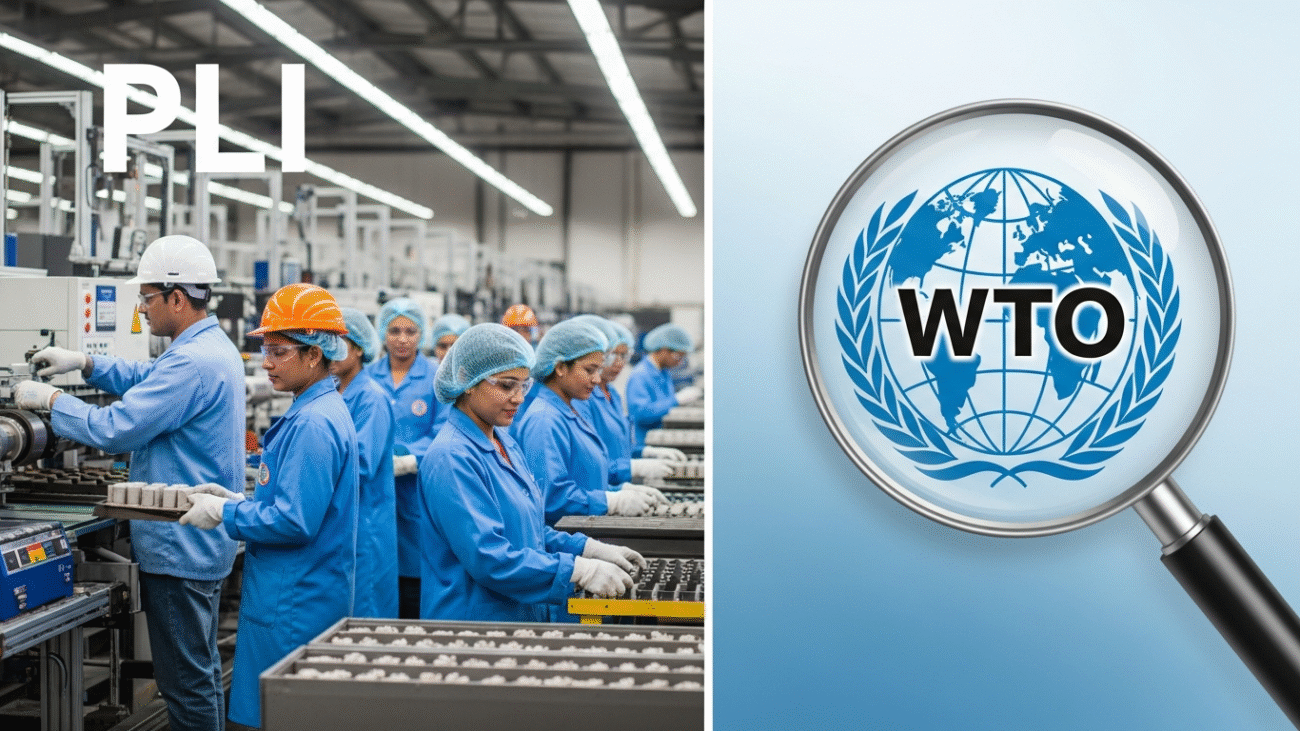
The final week of October 2025 delivered a mix of cautious de-escalation in major trade wars and a significant new dispute challenging India’s core manufacturing incentives. The global trade landscape saw temporary truces stabilizing the US-China and US-Korea relationships, even as a US government shutdown continued to ripple through supply chains. Most notably for your business as an Indian exporter, China officially challenged the Production-Linked Incentive (PLI) schemes at the World Trade Organization (WTO).
Major Trade Conflicts See Cautious De-escalation
The biggest headline of the week was the high-stakes meeting between US President Trump and Chinese President Xi Jinping in South Korea on October 30. The talks resulted in a temporary de-escalation, providing a much-needed pause for global markets and supply chains.
- US-China Tariff Truce: While a full trade deal was not signed, the leaders agreed to several confidence-building measures.
- The US agreed to lower the “fentanyl” tariff on China from 20% to 10%.
- China committed to delaying new rare earth export controls for one year, a major relief for global high-tech and defense manufacturing.
- China also agreed to resume purchases of American soybeans, a critical step for US agricultural exporters.
- Both sides suspended recently implemented port fees on each other’s vessels for one year, easing the burden on shipping logistics and costs.
- New US-South Korea Trade Deal: On October 29, the US and South Korea finalized key terms of a new trade agreement. The US will reduce its reciprocal tariff on South Korean goods from 25% to 15%. In exchange, South Korea will invest a substantial amount of capital annually into the US economy, including a major investment in the US shipbuilding industry.
- Impact on India: This US-China truce puts a sharper focus on India. With the US-China combined tariff rate now around 45% (30% existing + 10% reciprocal + 5% remaining fentanyl), India’s currently high 50% tariff on most goods remains the steepest globally. This dynamic makes a strategic trade deal with the US even more critical for Indian exporters to gain a competitive edge in sectors targeted under the “China plus one” strategy.
WTO Dispute Targets India’s PLI Schemes
In a significant development for India’s economic policy, China filed a formal complaint against India at the World Trade Organization (WTO) this week, alleging that India’s Production-Linked Incentive (PLI) schemes violate global trade rules.
- The Allegation: China claims that the PLI schemes for three key sectors—Advanced Chemistry Cell (ACC) Batteries, Automobiles, and Electric Vehicles (EVs)—provide prohibited subsidies. Specifically, Beijing argues that the incentives are contingent on Domestic Value Addition (DVA) requirements (e.g., 50% for autos, 25% for ACC batteries), which effectively encourage companies to use domestic goods over imported ones. This, China alleges, constitutes “Import Substitution” (IS) subsidies, which are inconsistent with the WTO’s Agreement on Subsidies and Countervailing Measures (SCM).
- India’s Position: The Indian government’s defense will likely focus on the argument that DVA requirements do not explicitly mandate the use of Indian goods. Value addition can occur through processing and transformation within the country, which may still involve imported components.
- Dispute Outlook: The first step is consultations between the two countries. Should they fail to resolve the issue, it moves to a WTO panel. Critically, because the WTO’s Appellate Body has been incapacitated since late 2019, any ruling against India that is appealed would remain in legal limbo, allowing the PLI schemes to continue in the interim. This uncertainty, however, highlights the growing global tension between national industrial policy (like India’s Atmanirbhar Bharat and Make in India initiatives) and multilateral trade rules.
Supply Chain & Logistics Challenges Persist
Global supply chains continued to face multiple headwinds this week, compounding costs and transit times.
- US Government Shutdown Impact: The ongoing US government shutdown, now in its fourth week, is causing logistics bottlenecks. While essential services like Customs and Border Protection (CBP) continue to collect tariffs, non-essential functions are curtailed.
- Regulatory Delays: Agencies like the Bureau of Industry and Security (BIS) are generally ceasing to process new or active export license applications and commodity classification requests, creating major delays for exporters worldwide.
- Trade Investigations: Activities like Antidumping and Countervailing Duty (AD/CVD) investigations at the Department of Commerce and the US International Trade Commission (USITC) are largely suspended, adding uncertainty to trade remedy cases.
- Shipping Rates and Volumes: Ocean freight rates remain soft due to weak demand following the front-loading of shipments ahead of previous tariff deadlines. The Drewry World Container Index continues its multi-week decline. However, port fees and labor disruptions are creating localized pressures. The US and China’s agreement this week to suspend retaliatory port fees on vessels will offer a slight relief to ocean freight costs on the Trans-Pacific route.
Source: The Hindu
Add a Comment