
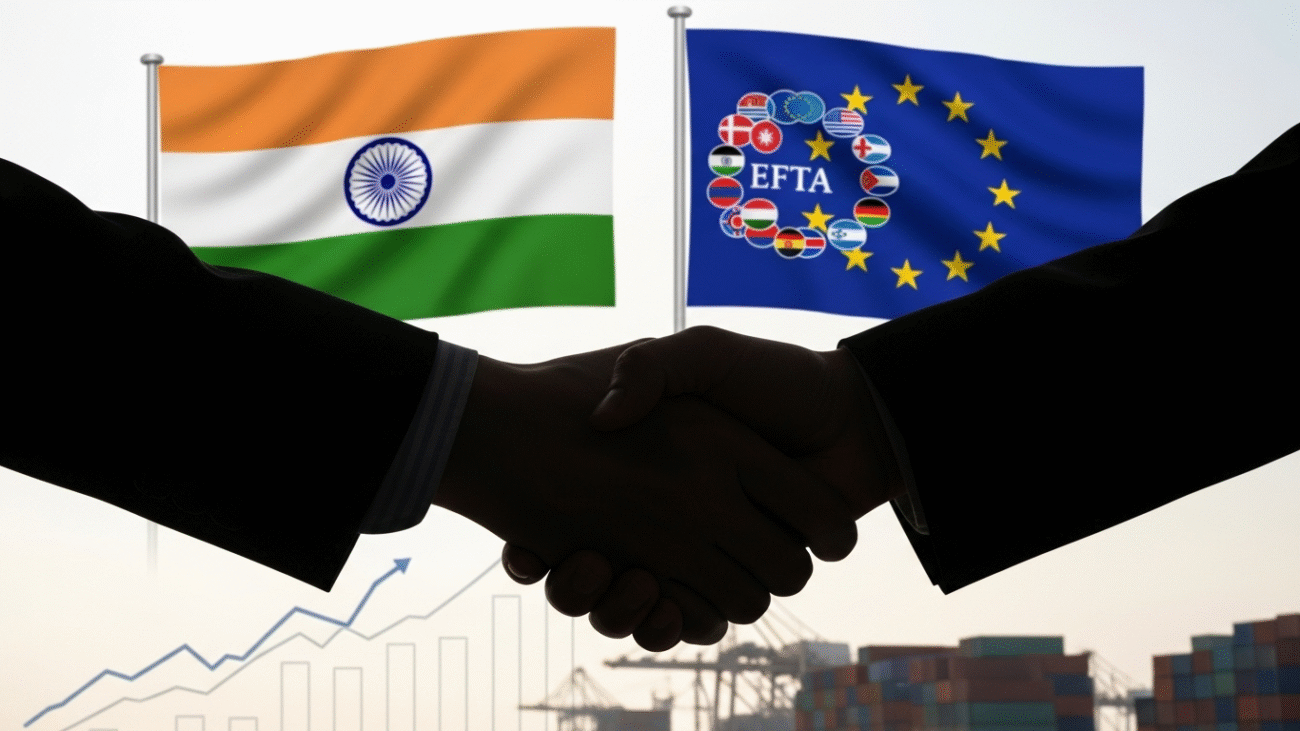
The week of October 5-11, 2025, marked a significant period for India Trade Policy and Agreements within the global market landscape. Key developments included the implementation of a major Free Trade Agreement (FTA), the continuation of high-stakes negotiations with a major bloc, and the anticipation of trade diversion resulting from escalating global tariff wars. These movements highlight India’s strategic push towards deeper economic integration and its positioning as a central player in the evolving world trade order.
India Trade Policy 2025: EFTA TEPA, EU Talks & US-China Impact
1. India-EFTA Trade and Economic Partnership Agreement (TEPA) Goes Live
The most definitive news of the week, though taking effect just prior to the start of the period, was the formal entry into force of the India-European Free Trade Association (EFTA) Trade and Economic Partnership Agreement (TEPA) on October 1, 2025. This landmark agreement, signed on March 10, 2024, establishes India’s first FTA with four developed European nations: Iceland, Liechtenstein, Norway, and Switzerland. The operationalisation of TEPA is poised to reshape bilateral trade and investment flows significantly.
Key Features and Market Impact:
- Investment Commitment: TEPA is historic as it incorporates a binding commitment for EFTA nations to invest $100 billion in India over the next 15 years, facilitating the creation of one million direct jobs. This unique clause underscores India’s focus on securing tangible economic benefits beyond simple trade liberalisation.
- Market Access for Goods:
- EFTA’s Offer: EFTA grants tariff concessions on 92.2% of its tariff lines, covering nearly 100% of India’s current exports, including all non-agricultural products. Indian exporters in sectors like machinery, organic chemicals, textiles, and processed foods will benefit from zero or reduced duties, boosting their competitiveness.
- India’s Offer: India offers tariff concessions on 82.7% of its tariff lines, covering 95.3% of EFTA’s exports, while judiciously protecting sensitive domestic sectors like dairy, soya, coal, and agriculture from undue competition.
- Ease of Trade: The agreement includes provisions for streamlined conformity assessment, mutual recognition of standards (MRAs), and simplified compliance, which are crucial for manufacturers of building materials and other goods, like those produced by Shiv’s Assets Group, to access the high-standard EFTA markets efficiently.
2. High-Stakes India-EU FTA Negotiations Advance
In a parallel and equally crucial development, India and the 27-nation European Union (EU) concluded the 14th round of negotiations for a comprehensive Free Trade Agreement (FTA) in Brussels. The five-day round, which commenced on October 6, focused on narrowing gaps in sensitive areas as both sides push to meet an ambitious target to conclude the deal by the end of December 2025.
Sticking Points and Indian Demands:
- EU’s Concerns: The EU continues to press India for deeper tariff cuts in sectors like automobiles and medical devices, along with lower duties on specific agricultural products, including wines and spirits. They are also advocating for a stronger Intellectual Property Rights (IPR) framework.
- India’s Concerns: India’s key demands include securing duty-free access for its labour-intensive exports (like ready-made garments and pharmaceuticals) and addressing the adverse impact of the EU’s upcoming Carbon Border Adjustment Mechanism (CBAM). CBAM, which began its reporting phase in late 2024, is set to impose a carbon tax on imports of steel, aluminium, cement, and fertilisers from January 2026, potentially creating new non-tariff barriers for Indian exporters.
The successful conclusion of this FTA would be a “game changer,” given the EU is India’s largest trading partner for goods, with bilateral trade reaching a high of $136.53 billion in the fiscal year 2024–25.
3. US-China Trade War Escalation: A Potential Windfall for Indian Exporters
The week also saw the further escalation of trade tensions between the US and China, which analysts anticipate could provide a significant, albeit challenging, opportunity for Indian exporters.
- Tariff Hike: The US announced an additional 100% tariff on Chinese goods, set to begin on November 1, 2025, in response to China’s new controls on rare earth exports (announced October 9, 2025). This move would raise the overall US tariff rate on Chinese imports to approximately 130%.
- India’s Advantage: Experts from the Federation of Indian Export Organisations (FIEO) suggested this escalation would shift global demand towards India. Sectors like textiles, toys, and certain electronics could see an influx of orders from American buyers seeking to circumvent the high Chinese duties. This creates a more level playing field for Indian goods, despite existing US tariffs on India.
- Trade Deal Uncertainty: The ongoing US-China tariff war serves as a cautionary tale for India, which is also in the midst of negotiating a bilateral trade agreement with the US. Trade analysts caution New Delhi to negotiate carefully, securing its own interests rather than relying on potentially shifting foreign policy positions.
Source Link: India-EFTA Trade Pact: Boosting $100 Billion Investment and 1 Million Jobs
Add a Comment