
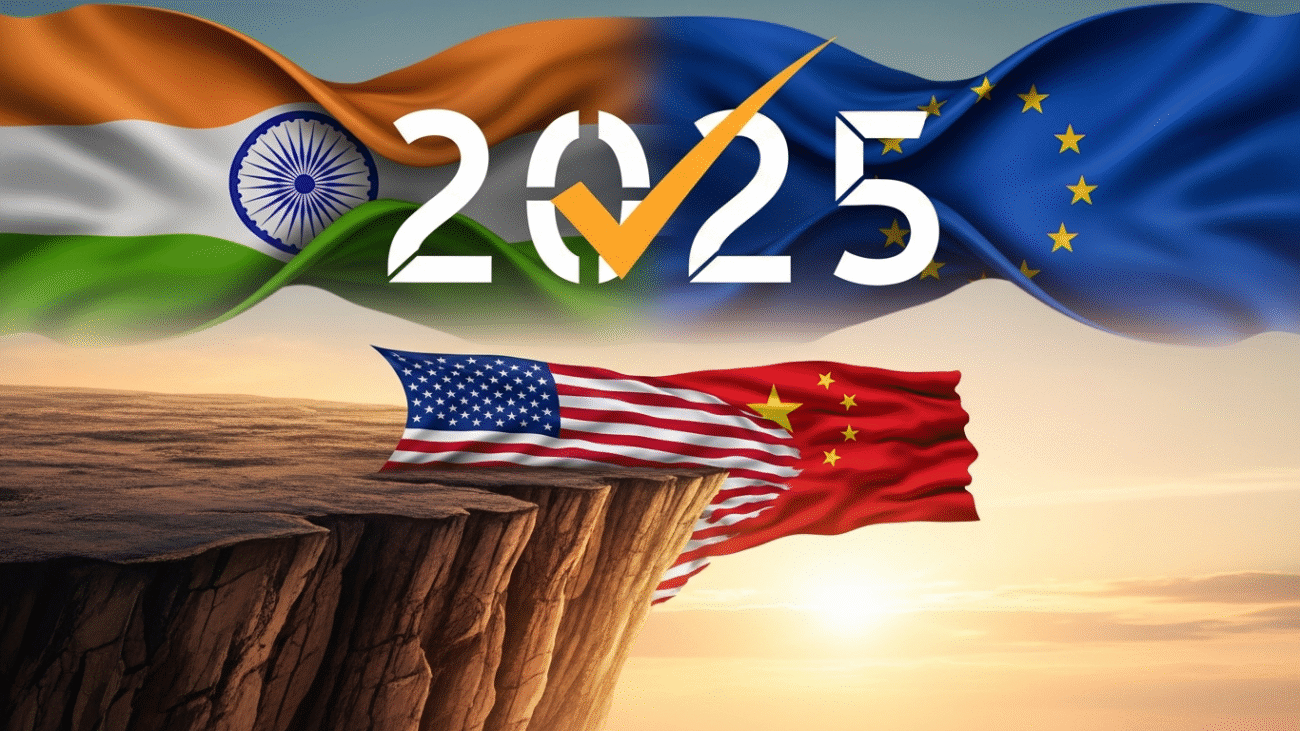
India FTA Deadline Set, 4 Global Trade Deals Reshape 2025
The week of October 26-31, 2025, was one of the most dynamic periods in global trade policy, characterized by high-level diplomatic pushes from India to finalize major Free Trade Agreements (FTAs) and a significant de-escalation of tensions between the world’s two largest trading nations, the US and China. For Indian exporters, these developments signal both new market opportunities and a temporary calming of global supply chain uncertainty.
1. 🇪🇺 India-EU FTA Deadline: Brussels Talks Cement Year-End Deadline
The most critical development for Indian trade policy was the visit of the Union Minister of Commerce and Industry, Shri Piyush Goyal, to Brussels from October 26-28, 2025. The purpose was to hold high-stakes discussions with the European Commissioner for Trade and Economic Security, Mr. Maroš Šefčovič, on the India-EU Free Trade Agreement (FTA).
-
Shared Commitment: Both sides reaffirmed their shared commitment to conclude the India-EU FTA by the end of 2025, following directives from their respective leaders earlier in the year. This renewed deadline adds significant pressure and political will to the final phase of negotiations.
-
Progress and Pain Points:
-
Areas of Agreement: Negotiators made productive strides toward finalizing the non-sensitive industrial tariff lines.
-
Major Hurdles: Key areas of divergence remain highly sensitive and require further high-level discussion. These include Steel, Automobiles, the Carbon Border Adjustment Mechanism (CBAM), and other emerging EU regulations. India is strongly advocating that the FTA must be balanced and not introduce new non-tariff barriers that disproportionately affect Indian goods.
-
-
India’s Focus: The Indian side stressed the need for preferential treatment for labour-intensive sectors, which are crucial for the country’s export-led growth. A balanced and equitable agreement that addresses both tariff and non-tariff barriers remains the core objective.
-
Next Steps: The EU technical team is scheduled to visit India the following week to build on the solutions identified during this round, demonstrating the accelerated pace of the talks.
2. 🇺🇸🇨🇳 US-China Trade Truce: Tensions De-escalate Tactically
A major temporary reprieve for global supply chains was agreed upon during the high-level meeting between US President Donald Trump and Chinese President Xi Jinping in South Korea on October 30, 2025.
-
The Agreement: The two powers reached a tactical agreement that temporarily eases the most recent tariff and export control escalations. This is not a final peace treaty, but a one-year stand-down on several punitive measures.
-
China’s Concessions: China agreed to postpone for one year the imposition of new export controls on critical minerals (like rare earths, gallium, germanium) and to resume significant purchases of US soybeans.
-
US Concessions: The United States agreed to reduce the “fentanyl tariff” on Chinese goods from 20% to 10% and postponed the implementation of new Section 301 measures (like those targeting China’s maritime and shipbuilding sectors) for one year.
-
Global Impact: This tactical truce provides much-needed respite for manufacturers and global commodity suppliers by securing the supply of critical minerals and slowing the decoupling trend. However, high tariffs (US weighted average tariffs on China remain around 47%) and geopolitical tensions still mandate that global companies, and platforms like The Exporter Hub, continue to diversify their supply chains toward alternatives like India.

3. 🇮🇳 India-EFTA TEPA Comes into Force
Marking a major milestone in India’s trade strategy, the Trade and Economic Partnership Agreement (TEPA) with the European Free Trade Association (EFTA) officially came into force on October 1, 2025 (news details and impact analysis continued to dominate the end of October).
-
Binding Investment: This is India’s first FTA that incorporates a binding commitment on investment and job creation, securing a pledge of $100 billion investment in India over the next 15 years, projected to create 1 million direct jobs.
-
Market Access: The EFTA bloc (Iceland, Liechtenstein, Norway, and Switzerland) has offered duty concessions on 92.2% of its tariff lines, covering nearly all of India’s exports, including textiles, machinery, processed food, and gems and jewellery. This provides The Exporter Hub users with significantly improved access to four developed European markets, complementing the anticipated India-EU FTA benefits.
4. 🇺🇸 USTR Bilateral Frameworks in Asia
The US initiated a series of bilateral trade frameworks across Southeast Asia, signaling a strategy of deepening ties with individual partners to balance regional influence.
-
Agreements Signed: The US signed framework trade agreements with Malaysia and Cambodia on October 26, 2025, addressing customs duties, non-tariff barriers, and intellectual property. Similar frameworks were announced with Thailand and Vietnam.
-
Reciprocal Trade: These agreements aim to establish a framework for reciprocal, fair, and balanced trade, focusing on stability and predictability. For instance, the Vietnam agreement includes a commitment for Vietnam to provide preferential market access for US industrial and agricultural exports. This US focus on diversified bilateral engagement highlights the complex network of agreements Indian exporters must navigate.
Source : Indian Minister’s discussions
Add a Comment