
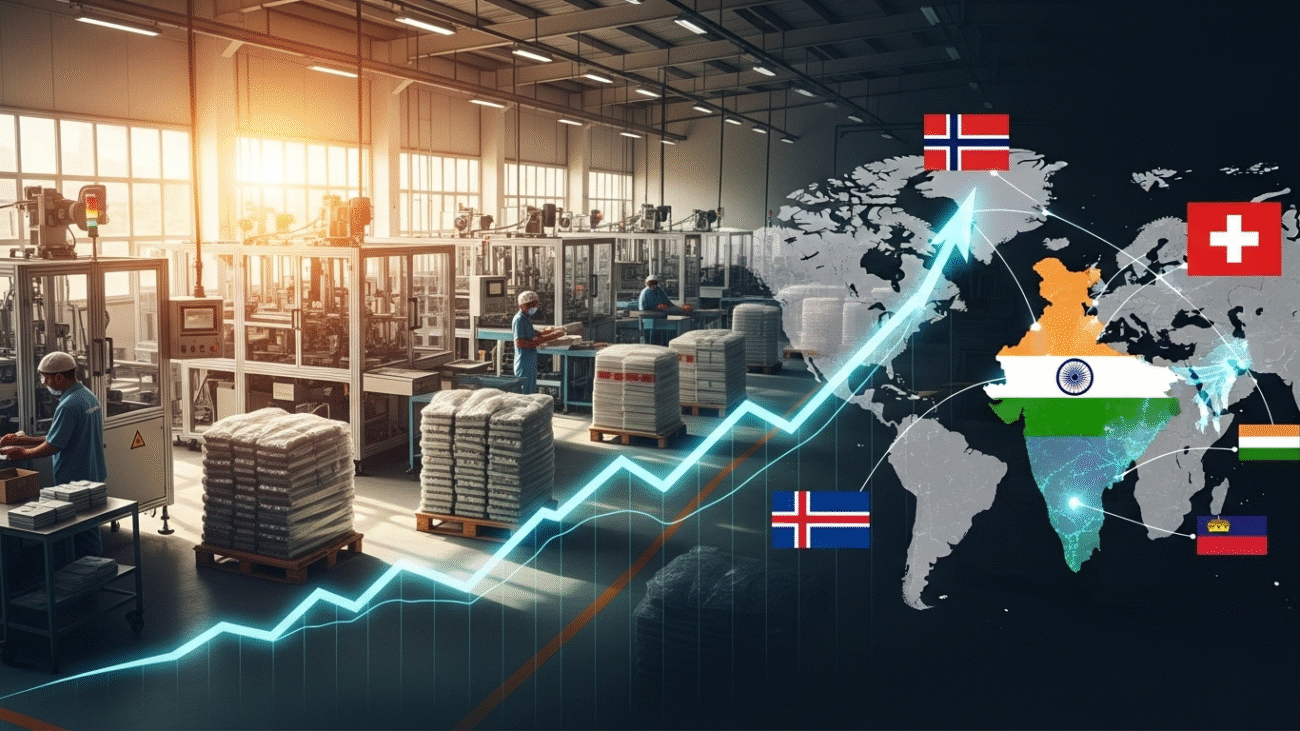
This week in global trade policy was dominated by two significant but contrasting stories: the implementation buzz around India’s landmark Free Trade Agreement (FTA) with the European Free Trade Association (EFTA), and a dramatic, albeit temporary, de-escalation of the renewed US-China trade war, primarily centered on critical materials.
For The Exporter Hub, the India-EFTA news signals a clear, high-opportunity pathway for Indian exporters in machinery, chemicals, and textiles, while the US-China dynamic continues to inject volatility into the global supply chain, particularly for high-tech and rare-earth-dependent sectors.
Feature Article: Trade Policy & Agreements News
Historic Pact: India-EFTA Agreement Takes Center Stage
The primary positive headline this period belongs to India. While the India-European Free Trade Association (EFTA) Trade and Economic Partnership Agreement (TEPA) officially came into force on October 1, the period of October 12–18 saw intense focus on the operational and long-term implications of this historic deal.
EFTA is an intergovernmental organization of Iceland, Liechtenstein, Norway, and Switzerland. TEPA is a watershed moment as it marks India’s first Free Trade Agreement with four fully developed European nations. Crucially, it’s also the first Indian FTA to include a binding commitment on investment and job creation, a landmark feature designed to ensure long-term, tangible economic benefits.
Key Commercial Advantages for Indian Exporters
The agreement offers substantial market access for Indian goods. EFTA countries have offered tariff concessions on 92.2% of tariff lines, covering 99.6% of India’s exports, including 100% of non-agricultural products. This means Indian exporters of goods like machinery, organic chemicals, pharmaceuticals, textiles, and processed foods now enjoy near-duty-free access to some of the world’s most prosperous consumer bases.
- Engineering and Chemicals: Sectors like organic chemicals and engineering goods, which are core to Indian manufacturing, are projected to see significant export growth due to tariff elimination or reduction—in some cases cutting pre-FTA duties of up to 54%.
- Services Mobility: Beyond goods, the agreement provides improved access for the services sector, a key area of strength for India. This includes greater certainty for the temporary entry and stay of key personnel (Mode 4), a major boost for IT, business, and professional services companies. This is vital for connecting your Indian exporter base with the specialized logistical and financial services of the EFTA nations.
The binding commitment by EFTA States is to aim to increase Foreign Direct Investment (FDI) into India by $100 billion over the next 15 years, coupled with the facilitation of 1 million direct jobs. This not only supports the ‘Make in India’ initiative but also provides a pipeline of new, advanced manufacturing and technology transfers.
US-China Tensions: Rare Earths Spark an Emergency De-escalation
On the other side of the trade coin, the week saw a dramatic flare-up and subsequent pause in the US-China trade conflict, driven by critical rare earth materials used in high-tech and defense manufacturing.
The recent escalation was triggered by China announcing sweeping new export controls on the critical rare earths industry, a move that targets the supply of materials essential for everything from smartphones to guided missiles and electric vehicle components. In swift retaliation, the US President had threatened to impose new, highly aggressive 100% tariffs on Chinese goods.
The Market Relief and the Looming Threat
The market volatility was palpable, but a key development emerged late in the week: both nations agreed to hold a new round of high-level trade negotiations in the coming days, prompting a temporary pause on further escalatory measures.
- Commodity Volatility: The immediate threat of 100% tariffs and the reality of rare earth export controls have kept markets highly sensitive. This dynamic directly impacts the raw material and commodity market globally, increasing the focus on supply chain diversification and strategic stockpiling by importing nations.
- Manufacturing Headwinds: For Indian exporters, particularly those dealing in finished goods that rely on electronics or specialized components, this uncertainty is a significant operational challenge. While the US and China talk, the global supply chain remains vulnerable to sudden policy shifts in the critical minerals space. The current “pause” is a fragile ceasefire, not a resolution.
This situation underscores the growing reality that trade policy is increasingly an instrument of national security, particularly in technology and critical minerals, moving beyond traditional tariff discussions.
Add a Comment