
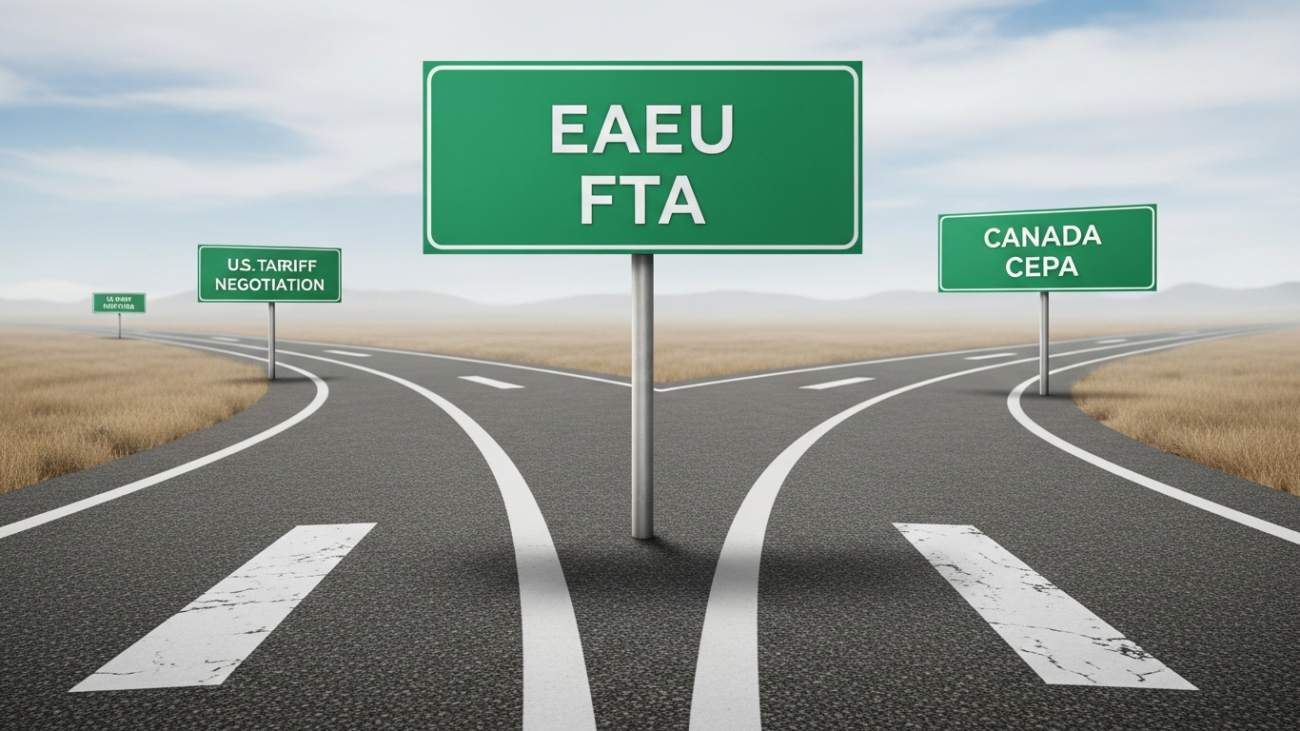
BOLD! India Launches 2 Massive New FTA Talks: Global Trade Shocks
The first week of December 2025 (Nov 30 – Dec 6) was a period of high-stakes diplomatic maneuvering, positioning India at the center of the global trade discussion. Amid intense pressure from US tariffs and a global trade system under stress, India aggressively pursued trade diversification, formalizing talks for major Free Trade Agreements (FTAs) with the Eurasian Economic Union (EAEU) and Canada.
This proactive approach is essential for Indian exporters, including those on The Exporter Hub platform, to secure new markets and counterbalance the unpredictability of traditional trade partners.
1. 🇮🇳🇷🇺 India-Russia Summit: Fast-Tracking the EAEU Free Trade Agreement
The biggest trade news of the week was the 23rd India-Russia Annual Summit held on December 5, 2025, during which President Vladimir Putin and Prime Minister Narendra Modi significantly advanced trade talks.
-
FTA Mandate: Both leaders directed their teams to “intensify efforts in negotiations” to achieve the early conclusion of a Free Trade Agreement (FTA) on goods between India and the Eurasian Economic Union (EAEU). The EAEU is a customs union comprising Russia, Armenia, Belarus, Kazakhstan, and Kyrgyzstan.
-
Trade Target: The summit reaffirmed the shared ambition to expand bilateral trade in a balanced and sustainable manner, working towards the ambitious target of $\text{\$100}$ billion by 2030.
-
Focus on Indian Exports: The joint statement emphasized the need to increase India’s exports to Russia to address the widening trade deficit (currently about $\text{\$64}$ billion in Russia’s favor). The FTA is seen as the primary vehicle to achieve this through reducing tariff and non-tariff barriers, particularly in sectors where India is competitive, such as pharmaceuticals, machinery, and agricultural products.
-
Logistics & Payments: The leaders also focused on key operational challenges for trade, agreeing to continue developing systems for bilateral settlements using national currencies and removing bottlenecks in logistics and insurance.
2. 🇨🇦 India Resumes Trade Talks with Canada: Focus on Critical Minerals
In a significant diplomatic thaw, India and Canada resumed discussions on launching negotiations for a proposed Comprehensive Economic Partnership Agreement (CEPA), or FTA, this week.
-
Official Discussions: Commerce Minister Piyush Goyal and his Canadian counterpart, Maninder Sidhu, held initial scoping discussions, focusing on the “overall approach, contours, macro objectives and modalities” for the restart of the CEPA talks.
-
Strategic Imperatives: This resumption is driven by mutual interest: Canada seeks market access for its agricultural and resource products, while India aims to secure critical minerals (like Uranium) and processing technology. The ambitious target is to boost two-way trade to $\text{\$50}$ billion by 2030.
-
Diversification Strategy: The simultaneous push for FTAs with the EAEU and Canada demonstrates India’s concerted strategy to diversify its market access and secure stable supply chains in a period of intense global geopolitical and tariff uncertainty.

3. ⚠️ WTO Highlights “Unprecedented” Disruption from Tariffs
The World Trade Organization (WTO) Director-General Ngozi Okonjo-Iweala issued a stark warning regarding the current state of global trade, which is highly relevant to the tariff threats faced by Indian exporters.
-
Eroding Rules-Based System: The WTO chief stated that the surge in country-specific and reciprocal tariffs, especially those enacted since April 2025, has caused “unprecedented” disruption to the rules-based global trade system.
-
Decline in MFN Trade: The share of global trade conducted under the WTO’s fundamental “Most Favored Nation” (MFN) terms has reportedly fallen from $\text{80\%}$ to about $\text{72\%}$ this year, signaling increasing fragmentation and the rise of protectionist blocs.
-
Impact Lag: The WTO warned that the full economic impact of the tariffs imposed in 2025 may only be felt “later down the line” into 2026, as companies exhaust stockpiles and begin to see the cost of trade barriers in their profit margins. This forecast of delayed impact provides a cautious long-term outlook for global trade growth.
4. 🇺🇸 US Tariff Threats and Exemptions
While India aggressively sought new agreements, the primary geopolitical headwind—the threat of US tariffs—remained active.
-
Unresolved $\text{50\%}$ Tariff: The threat of the $\text{50\%}$ punitive US tariff on Indian goods, linked to Russian oil imports, continues to pressure the trade relationship, although officials remain optimistic about an early resolution.
-
Brazil Exemption: In a notable move this week, President Trump issued an Executive Order exempting certain Brazilian agricultural products, including coffee and beef, from the previously imposed $\text{40\%}$ additional duty. This selective use of exemptions highlights the highly personalized nature of US trade policy, which creates both risk and opportunity for other trade partners like India.
Source : www.mea.gov.in
Add a Comment