
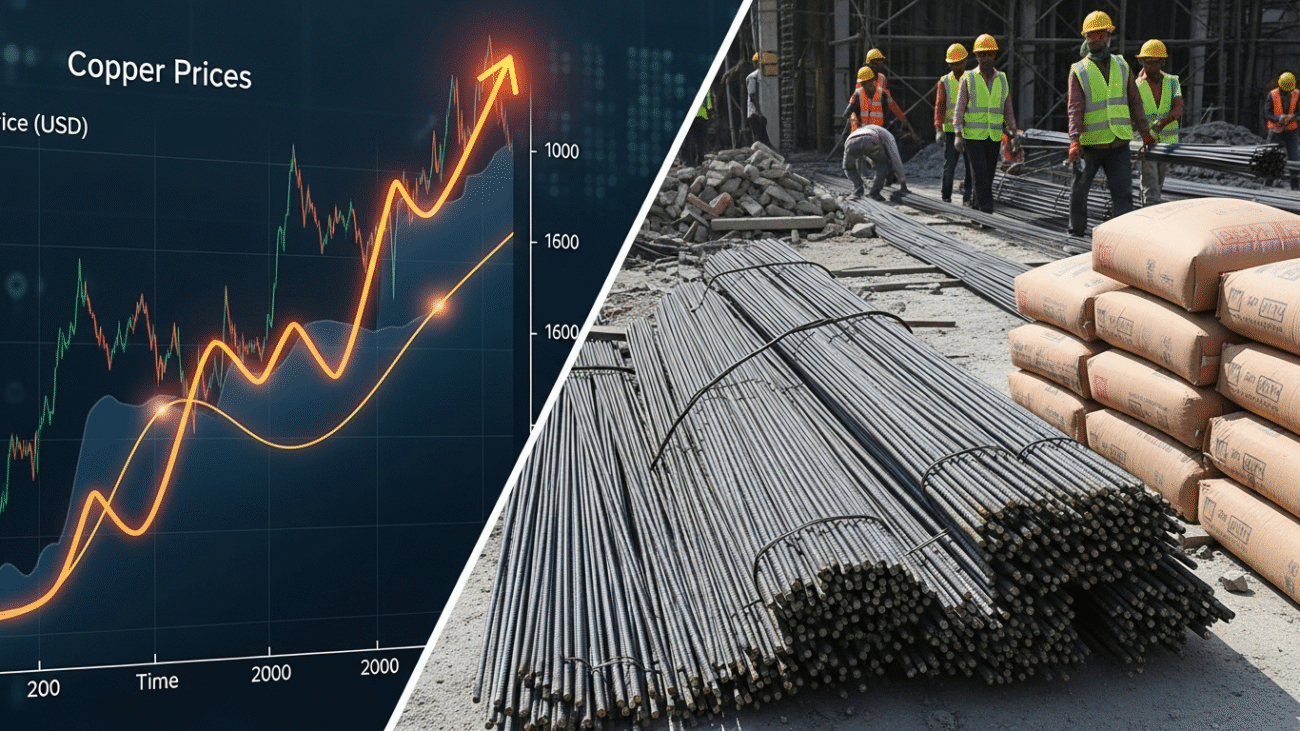
The raw material and commodity markets during the week of November 8-15, 2025, were defined by extreme price action in critical industrial metals and a sustained domestic stability and growth focus in India’s core building materials sector. The global copper market, a key indicator for industrial activity, experienced a landmark surge, while in India, steel prices maintained a firm footing, and the cement industry celebrated strong Q2 results and long-term expansion plans.
1. 🚨 Copper’s Record Rally: A New Strategic Commodity
The most significant event this week was the monumental rally in Copper prices, which surged to record highs, driven by supply deficits and global policy shifts.
-
Price Milestone: Copper futures on the London Metal Exchange (LME) briefly breached $11,000 per tonne this week. This surge reflects a severe structural deficit, meaning the world is unable to produce enough copper to meet accelerating demand.
-
Critical Mineral Designation: A primary driver of this rally was the formal designation of copper as a “critical mineral” by the United States Geological Survey (USGS) in early November. This policy shift elevates copper to a national-security asset, enabling domestic subsidies and trade prioritization for US projects, further tightening global supply.
-
Demand Drivers: The metal’s demand is accelerating due to global electrification efforts, the massive expansion of data centers (linked to the AI boom), and the integration of renewable energy grids. For sectors like the Shiv’s Assets Group (which deals in TMT Bars and construction), rising copper prices signal high confidence in future global construction and industrial production, but also potentially increased costs for electrical components and wiring in machinery.
-
Supply Constraints: This demand is colliding with limited mine-supply growth. The International Copper Study Group downgraded its 2025 mine-supply growth forecast, highlighting the impact of operational disruptions in key regions like Chile and the DRC.
2. 🇮🇳 Indian Steel and TMT Bars: Domestic Stability Prevails
Despite the global volatility in non-ferrous metals, the Indian steel market, crucial for TMT Bars and infrastructure development, showed resilience and minor upward pressure.
-
Price Trend: Domestic steel prices saw a slight inclination this week. The price was recorded around ₹39,060.00 per unit on November 11, 2025, continuing the general trend of stability supported by robust domestic consumption.
-
The Government Mandate: The sustained stability is a direct result of strong government capital expenditure, particularly the ₹11.21 trillion allocation in the 2025-26 Budget for infrastructure and housing projects. This high domestic demand buffers the Indian market against external pressures that might depress international steel prices.
-
Supply Chain Focus: For manufacturers, the steady pricing indicates predictable raw material costs, enabling better project planning and inventory management for the remainder of the quarter. Regional variations, as is typical, remain due to transportation costs and brand positioning.
3. 🏗️ Cement and Building Materials: Expansion and Decarbonization
The building materials sector continued to be a focal point of investment and innovation, driven by India’s massive infrastructure push.
-
Corporate Performance: Regional players like NCL Industries Limited reported robust Q2 FY26 results, with net profit soaring nearly eight-fold year-on-year. This performance reflects the positive market response to the earlier GST rate rationalization on cement and strong sales across diversified building material portfolios (including RMC and ready-to-use materials).
-
Industry Expansion: Industry analysts, including Crisil, project a massive expansion of India’s cement production capacity by 160–170 million tonnes between 2026 and 2028. This near-doubling of capacity addition compared to the previous three years is poised to meet the sustained boom in housing and infrastructure demand.
-
Decarbonization Drive: The 15th Cement Expo 2025 held this week in Delhi focused on the critical challenge of decarbonization. With India’s cement sector being a significant contributor to CO₂ emissions, the focus is on achieving a target of 670 million tonnes of production by 2030 while adopting low-carbon strategies, promoting sustainable materials like AAC Fly Ash Blocks and circular economy practices. This regulatory and market pressure ensures a long-term shift towards greener construction inputs.
4. 🪙 Precious Metals: Volatility on US Data Hopes
Precious metals experienced a volatile week, largely influenced by the anticipation surrounding the release of US economic data following the reopening of the US government.
-
Gold & Silver Movements: Gold and Silver prices initially gained, reflecting a relief rally on the prospect of the US government reopening, which improved investor sentiment. However, prices edged lower mid-week as markets priced in a lower probability of an immediate Federal Reserve rate cut.
-
Inflation Outlook: The expected release of delayed inflation (CPI) and employment data will be the immediate key drivers for precious metal prices. Analysts project high volatility, with the medium-term outlook for gold remaining firm, supported by global central bank buying and its traditional role as a hedge against inflation and financial instability.
Source : www.cruxinvestor.com
Add a Comment