
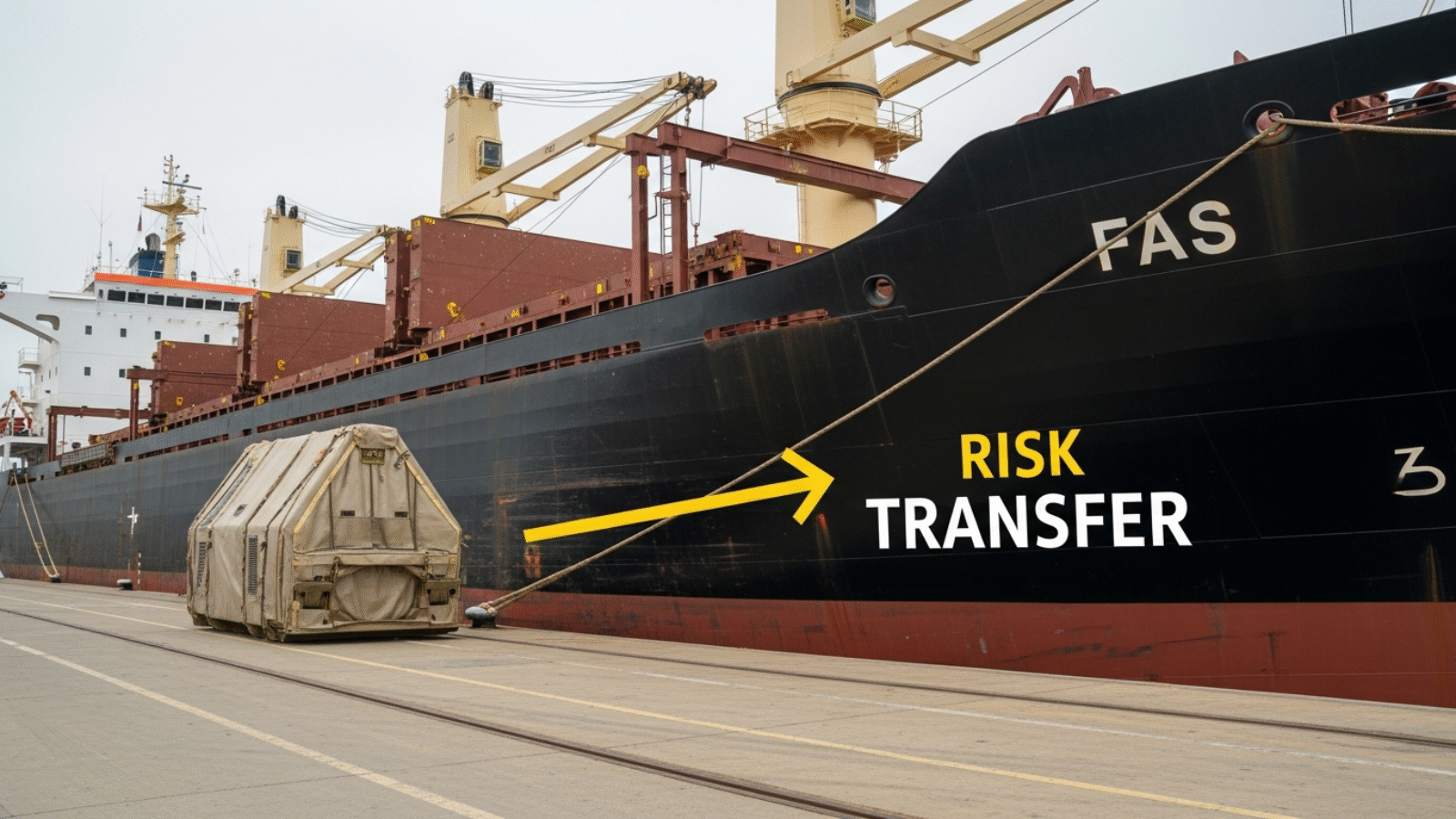
FAS Incoterm Introduction: The Term for Traditional Shipping
The FAS (Free Alongside Ship) Incoterm is a traditional rule primarily used for large, non-containerized goods, such as heavy machinery, grain (bulk commodities), timber, or large industrial equipment. It is one of the four rules strictly restricted to sea and inland waterway transport.
FAS is highly convenient for importers on TheExporterHub.com who specialize in purchasing raw materials or break-bulk cargo (goods shipped individually rather than in containers). Under FAS, the seller (exporter) takes on the cost and risk of getting the goods right up to the vessel, making it a natural choice when the buyer wants to control the main carriage contract.
1. What is FAS (Free Alongside Ship) Incoterm 2020?
Under the FAS Incoterm, the seller fulfills their delivery obligation when the goods are:
- Placed alongside the vessel (e.g., on the quay or a barge).
- At the named port of shipment.
- In the manner customary at that port.
Transfer of Cost and Risk
- Risk Transfer: Both the risk of loss or damage and the transfer of costs shift from the seller to the buyer when the goods are placed alongside the vessel.
- Exporter’s Responsibility: The seller handles all costs and risks until the goods are physically positioned next to the ship’s loading tackle. The seller is also responsible for Export Customs Clearance (a key difference from EXW).
- Importer’s Responsibility: The buyer takes on the cost and risk from the moment the goods are alongside the ship, including the critical and often expensive step of loading the goods onto the vessel.
2. FAS is for Bulk, Not Containers
The FAS Incoterm should not be used for containerized cargo, and here’s why:
- Container Logistics Reality: Containers are typically dropped off by the seller’s truck days before the ship arrives at a large, designated container terminal yard. They are not usually placed “alongside” a specific vessel. Once in the terminal stack, the seller loses all control.
- Risk Misalignment: Since the goods are handed over early in the terminal, using FAS would incorrectly delay the transfer of risk until the theoretical point “alongside the ship,” long after the seller has lost control.
Industry Advice: For containerized goods, FCA (Free Carrier) is the appropriate rule to use, as the risk transfers much earlier at the container yard or forwarder’s warehouse, aligning with the modern logistics process.
3. Exporter and Importer Responsibilities
FAS is a traditional “F-Term,” meaning the seller delivers the goods, and the buyer pays the main freight.
| Responsibility | Exporter (Seller) under FAS | Importer (Buyer) under FAS |
| Delivery & Risk | Bears all risk and cost until goods are placed alongside the vessel. | Assumes risk from the moment the goods are alongside the vessel. |
| Export Clearance | MANDATORY: Must obtain export licenses and handle all export formalities. | Not responsible. |
| Loading | Not responsible for loading the goods onto the vessel. | MANDATORY: Must arrange and pay for the cost and risk of loading. |
| Main Carriage | Not responsible for contracting or paying for the main freight. | MANDATORY: Must contract and pay for the main carriage and subsequent costs. |
| Insurance | Not responsible for the buyer’s risk during carriage. | Responsible for insuring the goods from the moment they are alongside the ship. |

4. FAS vs. FOB: The Loading Point Distinction
FAS and FOB are closely related and are the two Incoterms most relevant to the point of loading at the origin port:
- FAS: Seller’s responsibility ends alongside the vessel. Buyer loads.
- FOB: Seller’s responsibility ends on board the vessel. Seller loads.
When importing large, heavy cargo where the cost and risk of loading are substantial (e.g., using a specialized crane), FAS allows the buyer to retain control over that specific operation and its associated costs.
Conclusion: When to Use FAS
FAS is the essential Incoterm for the trade of non-containerized goods and bulk commodities where the loading operation is complex and often handled by the terminal or carrier contracted by the buyer. It allows the importer to centralize control over the main shipping logistics while ensuring the Indian exporter handles all necessary local transport and export clearance.
If you are shipping general merchandise in a container, stick to FCA. If you are shipping bulk grain, coal, or large pieces of equipment, FAS is the appropriate traditional rule.
Add a Comment