

The final week of 2025 (December 21 – December 27) has delivered a “tectonic shift” in the logistics world. As global traders finalize their 2026 supply chain strategies, the shipping industry has provided a clear signal: the era of the “Cape of Good Hope detour” is ending for many, but a new era of capacity management and digital verification is just beginning.
For the global community at The Exporter Hub, this week’s developments in the Red Sea, the Panama Canal, and the freight markets are the most critical data points for your Q1 2026 margins.
1. 🚢 The Great Return: Suez Canal Reopens for Majors
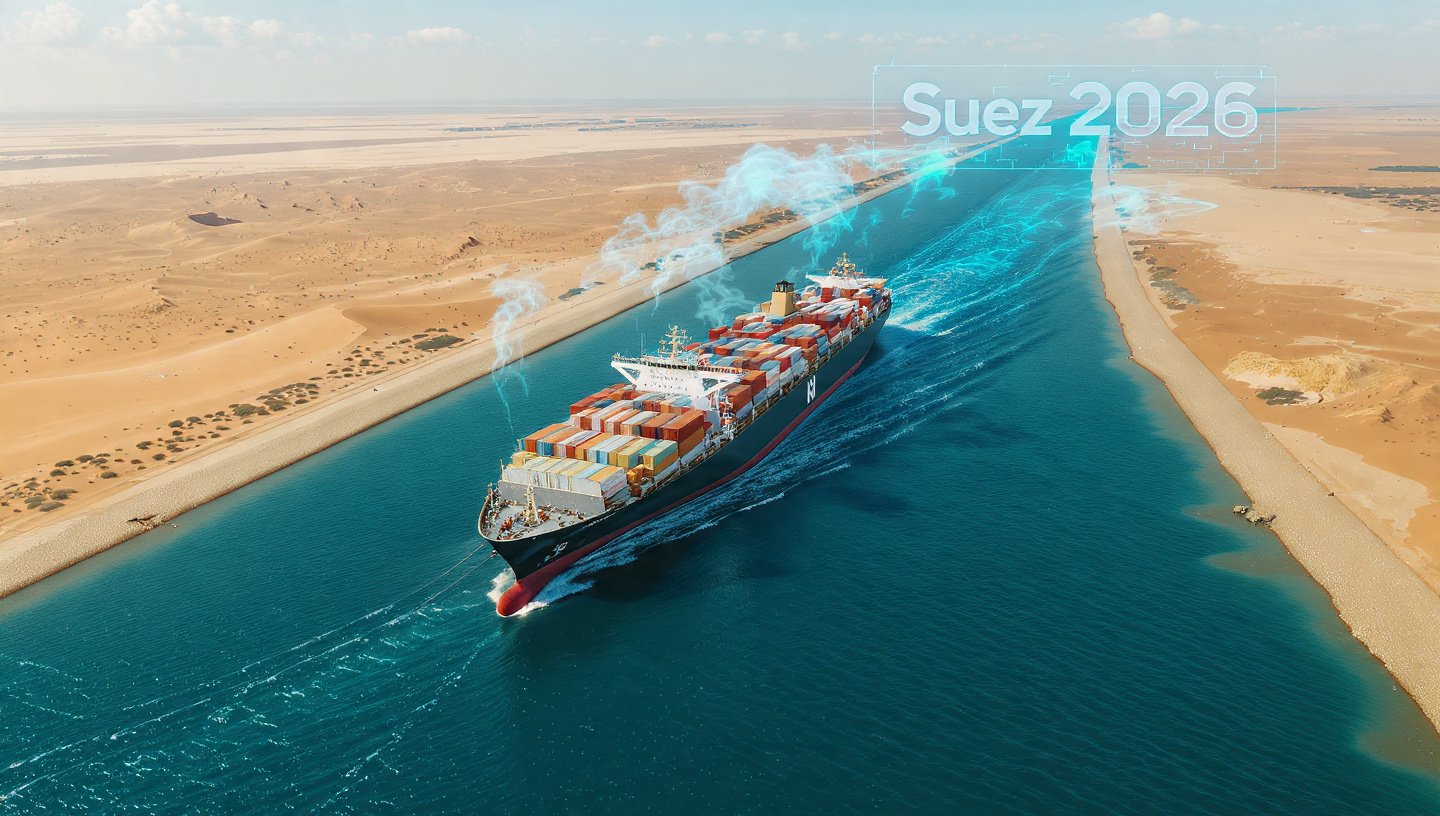
In a historic announcement on December 27, 2025, the Suez Canal Authority confirmed the beginning of a “normalization phase.” For the first time in nearly two years, major global carriers are returning to the Red Sea in a structural way.
-
CMA CGM’s Full Return: The French shipping giant has officially resumed full-loop transits. This week, the CMA CGM Jacques Saade (one of the world’s largest LNG-powered vessels) successfully transited the canal northbound, carrying 23,000 TEUs.
-
Maersk’s Gradual Re-entry: Following a landmark partnership agreement, the Maersk Sebarok transited the canal southbound this week. This marks the first Maersk vessel to use the Bab El-Mandeb Strait from Salalah to the U.S. in a scheduled capacity.
-
The Impact for Exporters: A return to Suez reduces transit times by approximately 14 days compared to the Cape route. However, global importers should expect a “capacity flood” that could destabilize freight rates as the additional “buffer” ships used for the long route are no longer needed.
2. 📈 Freight Market: The $2,213 Pivot Point
While volume traditionally thins during the Christmas week, the Drewry World Container Index (WCI) defied the holiday “demand freeze” by ticking up 1% to $2,213 per 40ft container. This marks the fourth consecutive week of increases.
-
Asia-Europe Surge: Spot rates from Shanghai to Genoa rose 3% to $3,427, while Shanghai to Rotterdam increased 2% to $2,584. Carriers are aggressively managing capacity through 75 blank sailings announced for this month—a 50% increase year-over-year.
-
Transpacific Stability: Rates to the U.S. West and East Coasts held steady at approximately $2,000 and $2,800 respectively.
-
The 2026 Forecast: Carriers are signaling a General Rate Increase (GRI) for January 1, 2026, aiming for a $1,000 hike. Global exporters should book now to lock in 2025 year-end levels before the Lunar New Year (mid-February) rush begins.
3. 🇵🇦 Panama Canal: LoTSA 2.0 and Toll Hikes
As of December 26, 2025, the Panama Canal Authority (ACP) finalized the transition to its new booking system, LoTSA 2.0 (Long-Term Slot Allocation), which takes effect on January 4, 2026.
-
Guaranteed Certainty: The new system allows shipping lines to reserve slots up to six months in advance. For global importers, this means more predictable arrival dates but higher costs.
-
The Price of Transit: Starting January 1, 2026, tolls for LNG and LPG carriers will increase by 11% to 17%.
-
Water Levels: Thanks to the La Niña phenomenon, water levels in Gatun Lake are stable, allowing for 36 transits per day—a significant recovery from the 2023-2024 drought crisis.
4. 🤖 The Digital Frontier: Hainan Hub & AI Robots
The week also saw two major leaps in logistics technology and infrastructure:
-
Hainan Free Trade Port: On December 18, China launched a full customs control regime on Hainan Island. This week, logistics providers began re-routing Asia-Pacific cargo to this new hub, which offers simplified customs and could soon compete with Hong Kong as a regional distribution center.

-
Agentic Shipping Platforms: The industry’s first “agentic” shipping platforms were deployed this week, using AI to automatically re-route cargo based on real-time tariff and weather data. This makes The Exporter Hub’s mission of document verification even more vital, as AI systems require clean, verified data to function effectively.
Source: India Shipping News – Suez Canal sees major container ships resume full transit (Dec 27, 2025)
Add a Comment