
Table of Contents
ACTION! US Moves to End 50% Tariff: 4 Policy Trade Shocks
The week of December 7-13, 2025, marked a crucial turning point in global Trade Policy and Agreements, driven by legislative action in the US and the fast-approaching compliance deadline for a major European climate regulation. The spotlight was firmly on India’s strategic trade relationship management with its two largest partners: the US and the European Union (EU).
For exporters on The Exporter Hub, the potential removal of the punitive US tariff and the imminent impact of the EU’s Carbon Border Adjustment Mechanism (CBAM) represent both the biggest risk and the greatest opportunity for 2026.
1. 🇺🇸 US Lawmakers Introduce Resolution to Terminate 50% Tariffs on India
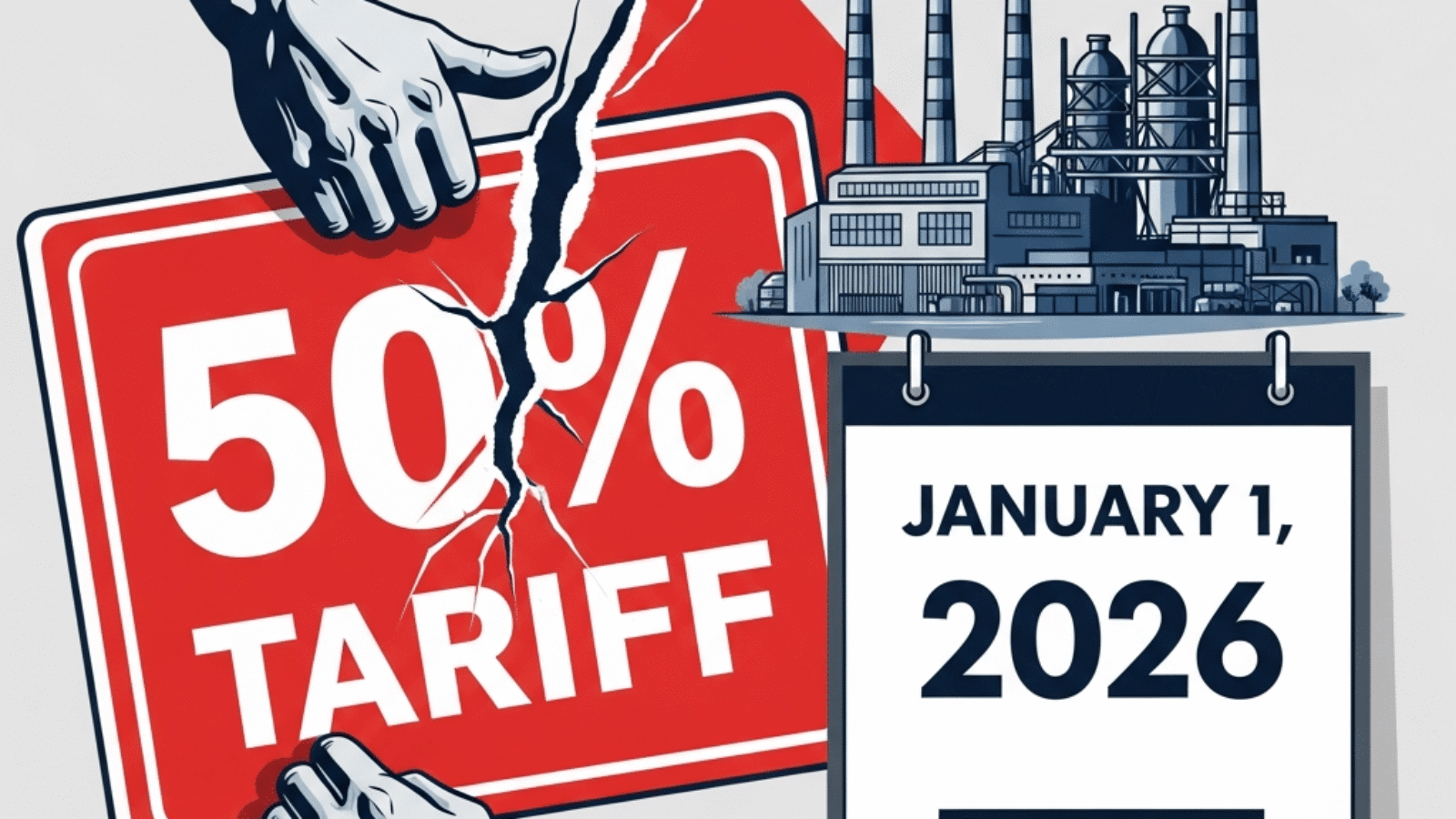
In the most significant development of the week, a bipartisan group of US lawmakers introduced a resolution in the House of Representatives aimed at immediately ending the 50% tariffs imposed by the current US administration on a wide range of Indian imports.
- Resolution to End Tariffs: On Friday, December 12, 2025, Representatives Deborah Ross (D-NC), Marc Veasey (D-TX), and Raja Krishnamoorthi (D-IL) introduced a resolution to terminate the “national emergency” invoked to justify the steep tariffs. They argued that the “irresponsible tariff strategy” toward India is counterproductive and weakens a critical strategic partnership.
- The 50% Breakdown: The resolution specifically targets the two parts of the duty:
- The initial 25% reciprocal tariff.
- The additional 25% “secondary” duty that took effect in August 2025, linked to India’s energy and defense purchases from Russia.
- Economic Impact Cited: Lawmakers highlighted that the tariffs, which affect nearly two-thirds of India’s $86.5 billion annual goods exports to the US, disrupt US supply chains, harm American workers, and drive up costs for consumers. Labour-intensive Indian sectors like textiles, apparel, gems, and seafood are considered the most vulnerable.
- Significance for India: This legislative move, while not guaranteeing repeal, signals powerful and rising Congressional pressure on the administration to reset trade policy and could provide a massive boost to Indian exporters currently facing the steepest trade shock in recent years.
2. 🇪🇺 CBAM Countdown: India Seeks Policy Clarity as Full Implementation Nears
With the EU’s Carbon Border Adjustment Mechanism (CBAM) moving from its transitional reporting phase to full financial implementation on January 1, 2026, Indian industry heightened its demand for clarity and government support.
- CBAM Implementation: Starting next month, importers in the EU must purchase CBAM certificates equivalent to the embedded CO emissions of imported goods (e.g., steel, aluminum, cement). For India, a major exporter of these energy-intensive products, the tax could be substantial.
- Export Diversification: Industry analysis confirmed that the introduction of CBAM will force Indian steel mills, which rely heavily on high-emission blast furnaces, to reorient their supplies away from the EU towards alternative markets in the Middle East and Africa, potentially leading to lower margins.
- India’s Counter-Strategy: India continued to signal its long-term response:
- WTO Challenge: Renewing its intent to challenge the mechanism at the WTO on grounds of non-discrimination.
- Domestic Carbon Pricing: Actively considering implementing a domestic carbon tax/pricing mechanism that would allow the Indian government, rather than the EU, to collect the carbon revenue, ensuring that Indian products remain compliant while the revenue supports domestic green transition efforts.

3. 🇦🇪 India-UAE CEPA Review: Tightening Gold Import Norms
Trade relations under the India-UAE Comprehensive Economic Partnership Agreement (CEPA), which crossed $100 billion in text{2024–25}, continued to be managed, with a specific focus on trade facilitation and regulatory tightening.
- Gold TRQ Amendment: The Directorate General of Foreign Trade (DGFT) issued a Public Notice amending the procedure for allocating the Tariff Rate Quota (TRQ) for gold imports under the CEPA. The key change mandates that eligible applicants for the TRQ must be registered with the Bureau of Indian Standards BIS for hallmarking and possess GST registration.
- Transparency and Compliance: This move aims to enhance transparency and efficiency in TRQ allocation, shifting to a competitive online bidding process. It reinforces India’s commitment to ensuring high-quality standards and curbing misuse within the FTA framework, an important step for the gems and jewellery sector.
4. 🌍 WTO: India Opposes China-led Investment Facilitation Proposal
At the World Trade Organization (WTO), India took a strong stance against a plurilateral agreement led by China on Investment Facilitation for Development (IFD).
- Sovereignty and Mandate: India formally raised legal and systemic objections, arguing that the WTO’s mandate does not cover non-trade issues like investment facilitation and that plurilateral agreements should not become the norm without the consensus of the entire membership.
- Protecting the System: This move reaffirms India’s traditional commitment to the multilateral, consensus-based system of the WTO and prevents the diversion of negotiation capital to areas that are not priorities for all developing and least-developed countries.
Source : www.thehindu.com
Add a Comment