
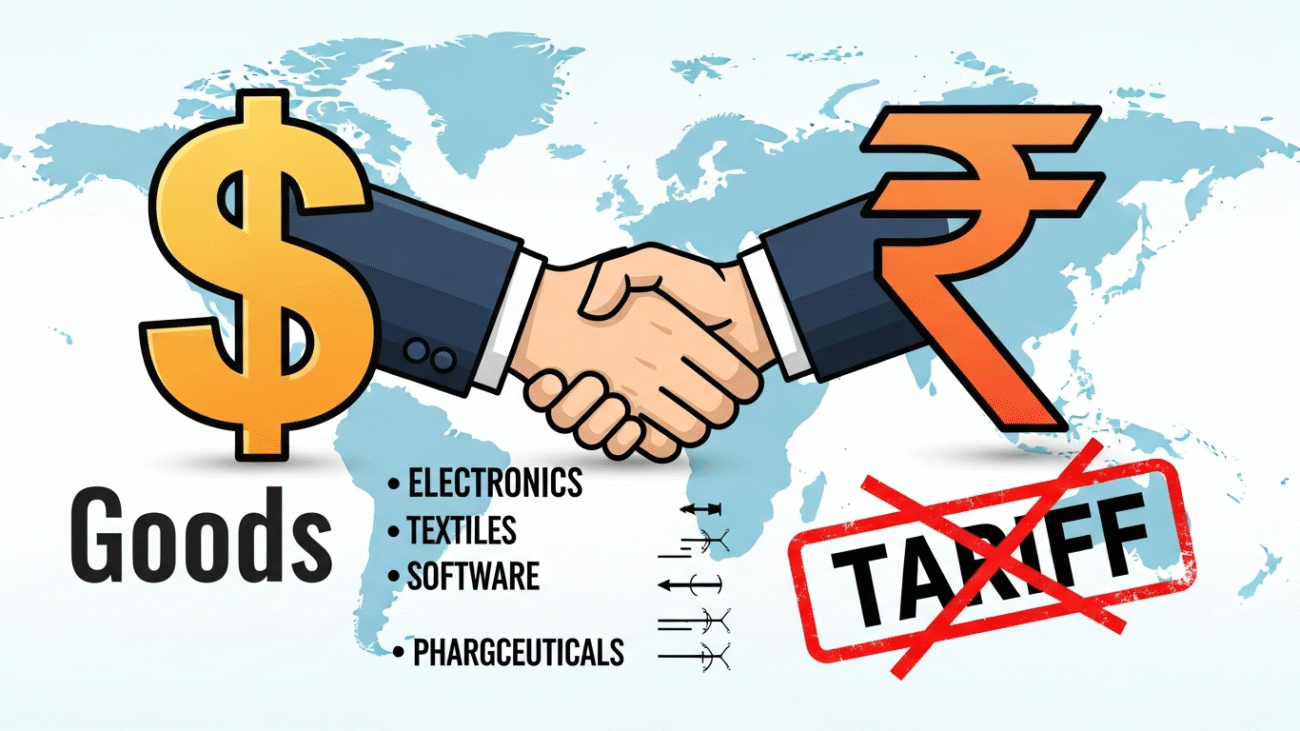
BREAKING! US-India Tariff Deal Closes: 4 Trade Policy Shocks
The week of November 23-29, 2025, was one of high-stakes diplomacy, with India making decisive progress on crucial trade agreements and facing new geopolitical pressures over its energy security. The central theme was the imminent resolution of the crippling India-US tariff dispute, which, when finalized, will provide a massive, immediate boost to Indian exporters, including those on platforms like The Exporter Hub.
1. 🇺🇸 India-US BTA: First Tranche on Tariffs “Near Closure”
The Commerce Secretary, Rajesh Agrawal, confirmed on November 17, 2025, that the first tranche of the proposed India-US Bilateral Trade Agreement (BTA), focused specifically on reciprocal tariffs, is “more or less near closure.” This indicates that a political announcement to resolve the most immediate trade friction is expected within weeks.
-
Targeting the 50% Tariff: This initial phase is designed to address the full $50\%$ tariff imposed by the US on a selection of Indian goods, which includes the $\text{25\%}$ reciprocal tariff and the additional $\text{25\%}$ punitive tariff linked to India’s purchases of Russian crude oil.
-
A “Fair and Equitable” Deal: Commerce Minister Piyush Goyal reiterated that any deal would only be signed once it is “fair, equitable and balanced,” ensuring the interests of sensitive Indian sectors like farmers and fishermen are safeguarded.
-
Core Concessions: Reports suggest that to finalize this tranche, India is considering allowing imports of US soyabean and corn, and limited imports of certain dairy products under strict safeguards. For the US, the agreement will address market access for its industrial and agricultural goods.
-
The Exporter Impact: For exporters, particularly those dealing in high-value goods like engineering products, drugs and pharmaceuticals, and textiles, the withdrawal of the punitive 50% tariff will immediately restore price competitiveness in the largest global market, unlocking significant export growth potential as India targets $\text{\$500}$ billion in bilateral trade by $\text{2030}$.
2. 🇮🇳✈️ Commerce Minister Leads High-Level Mission to Israel
In a push to strengthen India’s bilateral economic and technology ties outside of traditional trade partners, Commerce and Industry Minister Piyush Goyal led a high-level trade mission to Israel from November 20 to 22, 2025.
-
FTA Progress in Focus: A core agenda item of the visit was to assess and drive progress on the proposed India-Israel Free Trade Agreement (FTA). Israel is a critical partner in high-tech sectors, defense, and water management.
-
Business Delegation: The Minister was accompanied by a large delegation of 60 Indian business members, emphasizing the high mutual interest in establishing joint ventures and expanding trade partnerships in innovation, manufacturing, and technology.
-
Strategic Collaboration: Discussions covered investment flows, collaboration in cyber security, smart mobility, and life sciences. This trip underscores India’s strategic policy of diversifying its economic engagement to secure technology access and promote advanced manufacturing partnerships.

3. ⚖️ Sanctions Deadline & Energy Policy Pressure
The ongoing US policy regarding Russian energy imports reached a critical point this week, directly impacting India’s trade policy decisions.
-
Russian Oil Sanctions: The US Treasury Department’s wind-down deadline for sanctions on two major Russian oil majors, Rosneft and Lukoil, came into effect on November 21, 2025.
-
Policy Impact: While the 50% punitive tariff on Indian goods has not stopped India from buying Russian crude entirely, the direct sanctioning of these entities forces Indian refiners to adopt a more cautious approach. Companies like Reliance Industries Ltd have signaled they will stop importing from sanctioned entities at their export-focused refineries, aligning their operations with the US sanctions regime.
-
Trade Policy Pressure: This pressure is directly linked to the BTA negotiations, as the US is keen for India to reduce Russian oil purchases. India’s energy policy continues to prioritize affordability and security, leading to complex trade-offs in its negotiations with the West.
4. 🇪🇺-🇹🇹 EU Launches Dialogue with Trans-Pacific Bloc
In a move to reinforce multilateralism and establish new alliances, the European Union (EU) launched its first Trade and Investment Dialogue with the Comprehensive and Progressive Agreement for Trans-Pacific Partnership (CPTPP) bloc on November 20, 2025, in Australia.
-
Strategic Alliance: The EU and CPTPP partners collectively represent about $\text{37\%}$ of global trade, making this a powerful alliance committed to open, rules-based trade and World Trade Organization (WTO) reform.
-
Key Focus Areas: The dialogue will focus on supply chain resilience, trade diversification, and digital trade. This collective action by major trading powers signals a growing consensus that the global trade environment requires new structures to counter protectionism and geopolitical threats. This aligns with India’s long-term goal of leveraging its own bilateral agreements (like the forthcoming EU-India FTA) to enhance its global standing.
Source Link : www.aninews.in
Add a Comment