
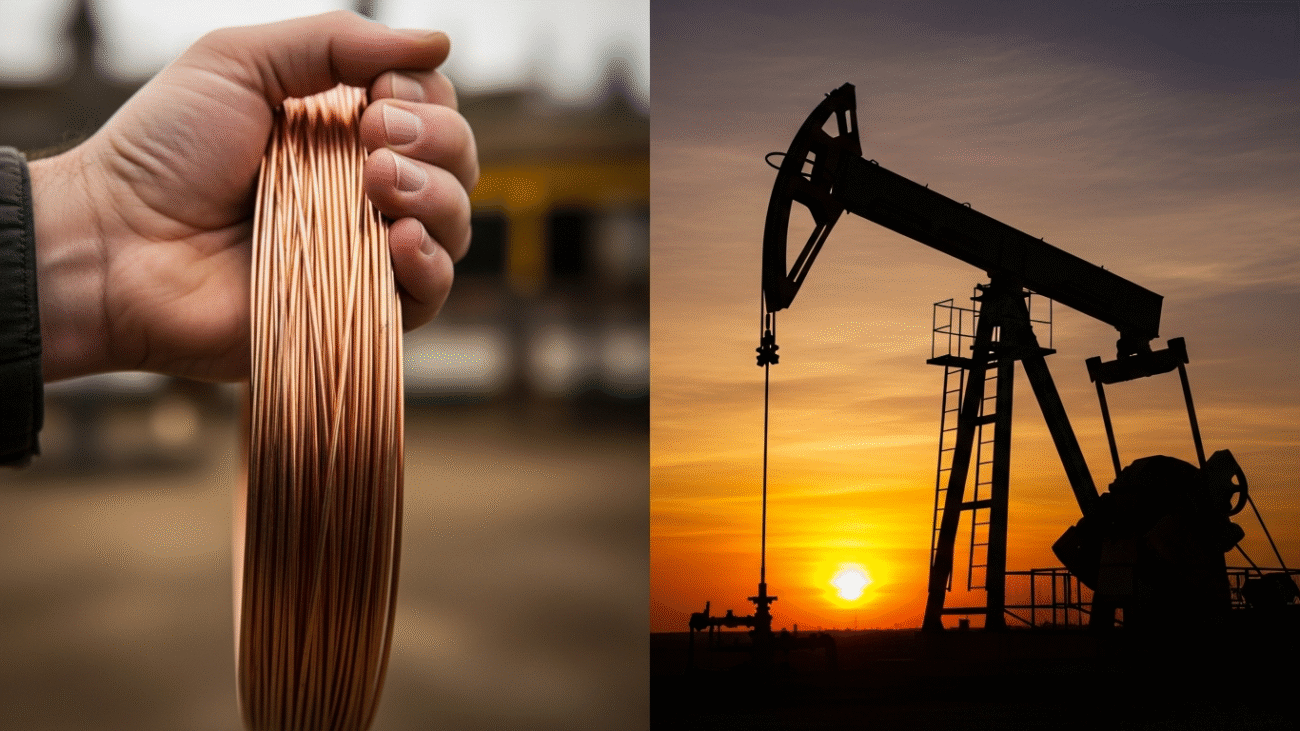
The global Raw Material and Commodity Market during the week of November 23-29, 2025, was defined by extreme divergence across key sectors. While Base Metals, particularly Copper, experienced a powerful bullish rally driven by acute global supply deficits, Energy commodities and Aluminum struggled with weak demand and oversupply fears.
This volatility is critical for Indian manufacturers like those in the user’s business (Shiv’s Assets Group), as it directly impacts the input costs of materials like TMT Bars (steel), which rely on base metals and energy for production.
1. 📈 Copper Enters Bull Market: Supply Deficits Drive Prices to New Highs
Copper was the star performer this week, surging to a near three-year high on global exchanges, propelled by intensifying supply disruptions and strong long-term demand outlooks.
-
Supply Crisis Confirmed: Analysts from major global banks (including J.P. Morgan and UBS) significantly raised their copper price forecasts for 2026, citing an acute and persistent global refined copper deficit. This tightness is largely due to:
-
Major Mine Disruptions: The fatal mudslide at the Grasberg mine in Indonesia (the world’s second-largest copper mine), along with slower-than-expected output recovery in Chile and operational challenges at other key sites, has crippled global supply.
-
Negative Treatment Charges: The fee smelters charge to process raw copper concentrate (known as Treatment Charges, or TCs) has turned deeply negative for the first time in recent memory. This signals an intense shortage of raw material, forcing smelters to pay for concentrate, which is historically an anomaly.
-
-
India’s MCX Trading: On the Multi-Commodity Exchange (MCX), Copper futures for December delivery rose to trade near $\text{₹}1,021$ per kilogram due to this firm spot demand and global scarcity.
-
Long-Term Outlook: Analysts project prices could soar to $\text{\$12,500}$ per metric tonne ($\text{/mt}$) in 2026, up from current levels around $\text{\$11,200}$/mt. The bullish sentiment is cemented by demand drivers from the energy transition—Electric Vehicles (EVs), renewable energy infrastructure, and data centers.
2. 📉 Aluminum Prices Slip Amid China’s Demand Worries
In contrast to copper, Aluminum experienced downward pressure, particularly on the domestic Indian market, due to weakening demand signals from the world’s largest consumer, China.
-
LME Highs vs. Domestic Decline: While LME Aluminum prices were still trading near a three-year high (around $\text{\$2,800}$ $\text{/tonne}$) driven by European energy cost concerns and Chinese production limits, Indian domestic aluminum prices saw a modest decline ($\text{0.64\%}$ drop to $\text{₹}270.45$ per kilogram).
-
The China Factor: This weakness was attributed to a rise in Chinese Shanghai Futures Exchange (SHFE) inventories and a structural economic slowdown in China, which dampened overall trading sentiment and reduced demand for imports from consuming industries.
-
Policy Counterweight: Market sentiment was supported slightly by the expectation of an upcoming US Federal Reserve rate cut, which generally supports broader commodity markets. However, the domestic market focused on immediate slackened demand.

3. 🛢️ Crude Oil: Prices Steady, But Long-Term Outlook Remains Bearish
Crude oil markets traded in a narrow, steady range during the week, with all eyes fixed on the upcoming OPEC+ ministerial meeting, yet long-term forecasts remained overwhelmingly bearish.
-
Market Calm: Brent Crude futures and WTI saw only marginal daily fluctuations, maintaining relative stability. This calm was attributed to market anticipation that OPEC+ would stick to its current output strategy and avoid further production hikes, aiming to implement existing cuts fully.
-
The Oversupply Threat: Despite OPEC+’s cautious stance, major investment banks like J.P. Morgan reiterated a dire long-term forecast, projecting that Brent crude could tumble into the $\text{\$30s}$ by the end of FY27 if non-OPEC+ supply (from US shale and offshore developments) continues to grow at its current pace.
-
India’s Tailwind: This looming oversupply scenario is a significant macroeconomic positive for India, which imports $\text{85\%}$ of its crude. Lower oil prices directly reduce the import bill, help control inflation, and support the Indian rupee.
4. 🏗️ Indian Steel Prices Fluctuate Amid Inventory Pressure
The domestic Indian steel market, critical for the user’s business dealing in TMT Bars, saw mixed sentiment this week.
-
Price Volatility: While the overall India steel index edged up marginally ($\text{0.2\%}$ week-over-week), the market remained subdued. Initial price hikes by mills at the beginning of the week were not absorbed by the trade market, forcing some major players to slash list prices later in the week.
-
Key Pressure Points:
-
High Inventories: Elevated inventory levels at distributors and company yards, coupled with liquidity constraints, continued to weigh down market sentiment.
-
Weak Global Sentiment: Global steel prices and export sentiment, especially from China, remained weak, preventing a strong domestic recovery despite robust demand from the infrastructure sector.
-
-
Raw Material Margin Squeeze: Domestic iron ore and coking coal prices remained firm, creating a margin squeeze for primary steel producers as finished product prices failed to rise accordingly.
Source Link : www.mining.com
Add a Comment